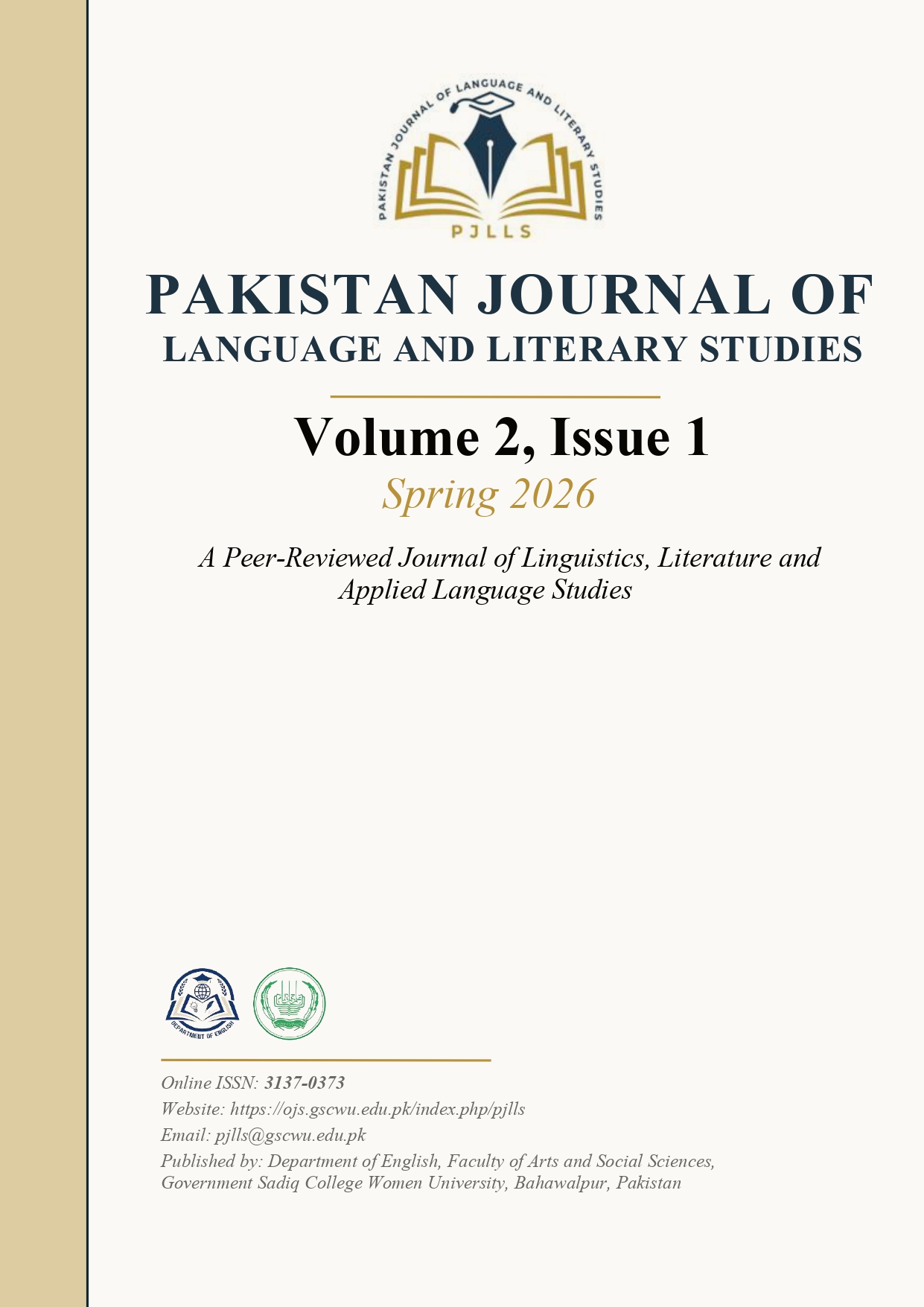
Slavery, Trauma and Healing: A Corpus-Based Analysis of Temporal Markers in Selected African-American Neo-Slave Narratives.
Keywords:
Temporal markers, Corpus linguistics, Neo-slave narratives, Trauma theory, Healing.Abstract
The study explored the frequencies of temporal markers in selected African-American Neoslave narratives, combining corpus linguistics with literary studies. These narratives focus on the historical experiences of slavery and its continuing psychological effects. While these narratives have been largely studied for their themes of trauma, history, identity and memory, limited attention has been given to linguistic features that shape them. The role of temporal markers and their contribution to representing trauma and healing remained under-explored. The study employed a sequential mixed-methods design, analyzing a corpus of five African American Neo-slave narratives, Beloved, Homegoing, Kindred, Underground Railroad, and The Water dancer, consisting of 540,843 words. AntConc was used to generate frequency lists and concordance lines of temporal markers, while NVivo was used to code the extracted data according to Dominick LaCapra’s trauma theory. The findings revealed that past oriented temporal markers are abundant in the corpus. This presence supports LaCapra’s trauma theory concept of Acting Out. Present and future-oriented markers revealed a progression toward healing corresponding to LaCapra’s Working Through phase. This imbalanced distribution, with Acting Out coded 212 times against 146 for Working Through, showed the complex but progressive nature of healing within these narratives. It offered an empirical framework for understanding the relationship between language, trauma, and healing. The study provided insights into psychological research by highlighting how language simultaneously recorded and transformed the effects of historical trauma, suggesting that healing remains gradual or incomplete rather than fully resolved in trauma narratives. The study contributed to both corpus linguistics and trauma studies, suggesting that temporal markers can be measured as evidence of psychological state rather than only interpreted through close reading.
Downloads
Published
Issue
Section
License
Copyright (c) 2026 Pakistan Journal of Language and Literary Studies

This work is licensed under a Creative Commons Attribution-NonCommercial 4.0 International License.
Articles are published under the Creative Commons Attribution-NonCommercial 4.0 International License. Anyone may share and adapt the work for non-commercial purposes, provided appropriate credit is given to the author(s) and the journal.